
Sharp Lower Back Pain on One Side? It Could Be a Lumbar Facet Joint Irritation (London Guide)
If you’re an active adult in London dealing with sharp, localised lower back pain that feels worse when standing or arching backwards, there’s a strong possibility your lumbar facet joints are involved.
Most people assume all lower back pain is disc-related - they get all the attention.
In reality, lumbar facet joint conditions are common, particularly in athletic individuals who train regularly, sit for long hours, or load their spine repeatedly in extension. Common sports include tennis (from serving repetitively), Crossfit and Olympic Weightlifting (overhead exercises) or runners!
As a Sports & Spinal Physiotherapist in London specialising in athletic adults with persistent lower back pain, this is something I assess and treat frequently.
Let’s break it down clearly.
What Are Lumbar Facet Joints?
In your lower back (lumbar spine), each vertebra connects to the one above and below via two small joints at the back — called facet joints.
Their role is to:
Guide spinal movement
Control extension and rotation
Stabilise the spine under load
If the disc is the shock absorber at the front, the facet joints are the control system at the back.
They are essential structures.
But when repeatedly compressed — especially in extension — they can become irritated.
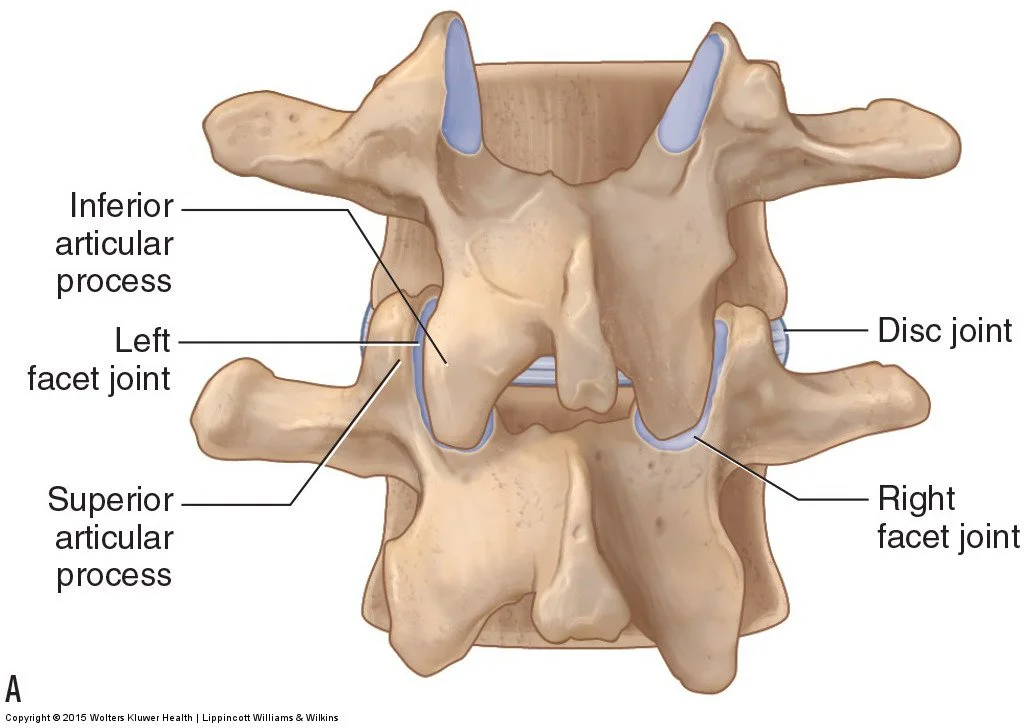
Symptoms of Lumbar Facet Joint Pain
Lumbar facet joint pain usually has a fairly recognisable pattern.
Common symptoms include:
Sharp, intense, well-localised lower back pain
Usually more prominent on one side
Pain worse when arching backwards
Pain worse with prolonged standing
Relief when sitting or bending forward
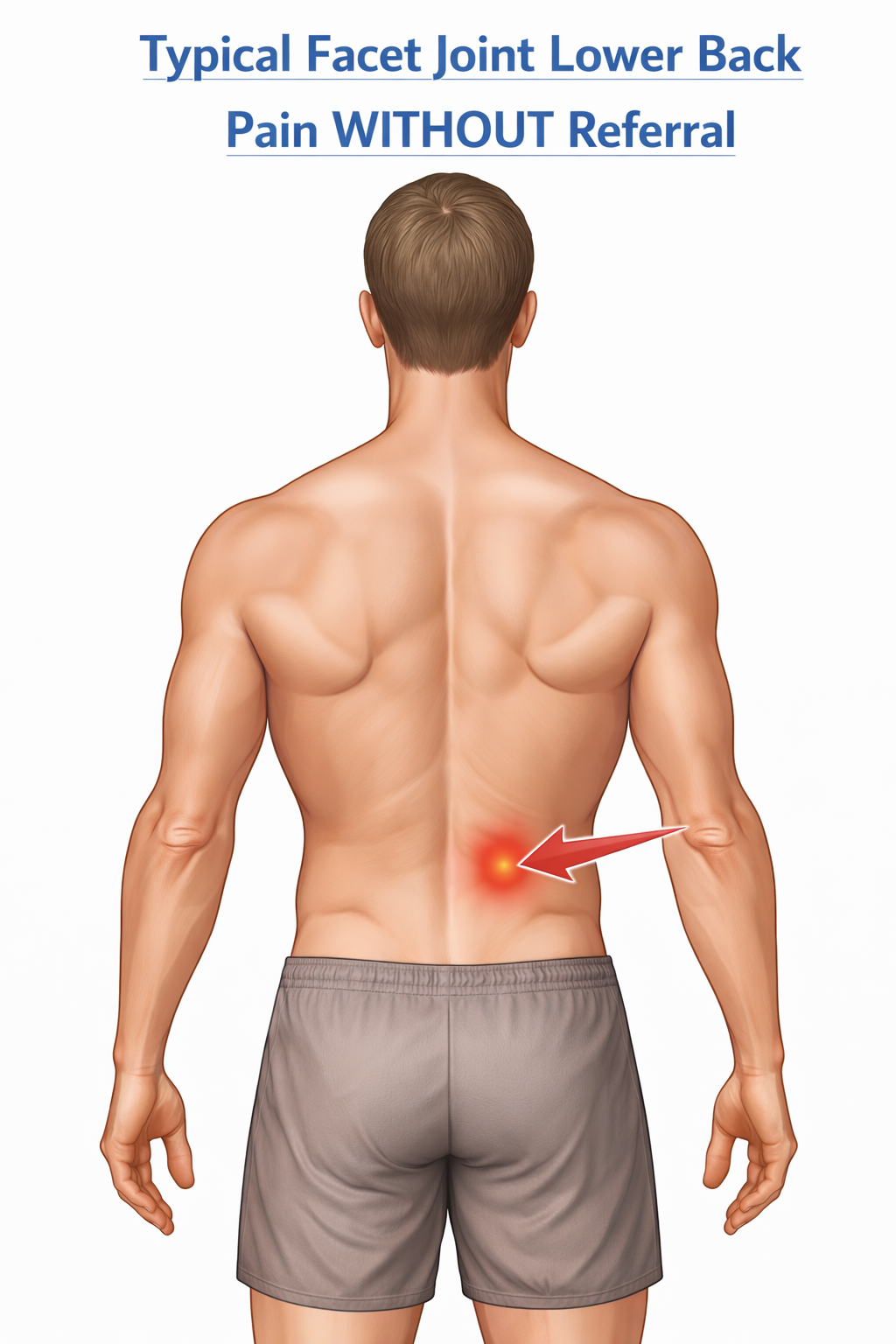
If there is referred pain, it:
May travel into the buttock or upper thigh
Usually does NOT travel past the knee
That distinction matters.
If pain is travelling below the knee with pins and needles or numbness, we consider disc involvement more strongly.
Facet pain is typically mechanical and localised.
If you’re unsure whether your symptoms are facet-related or disc-related, you may find this helpful:
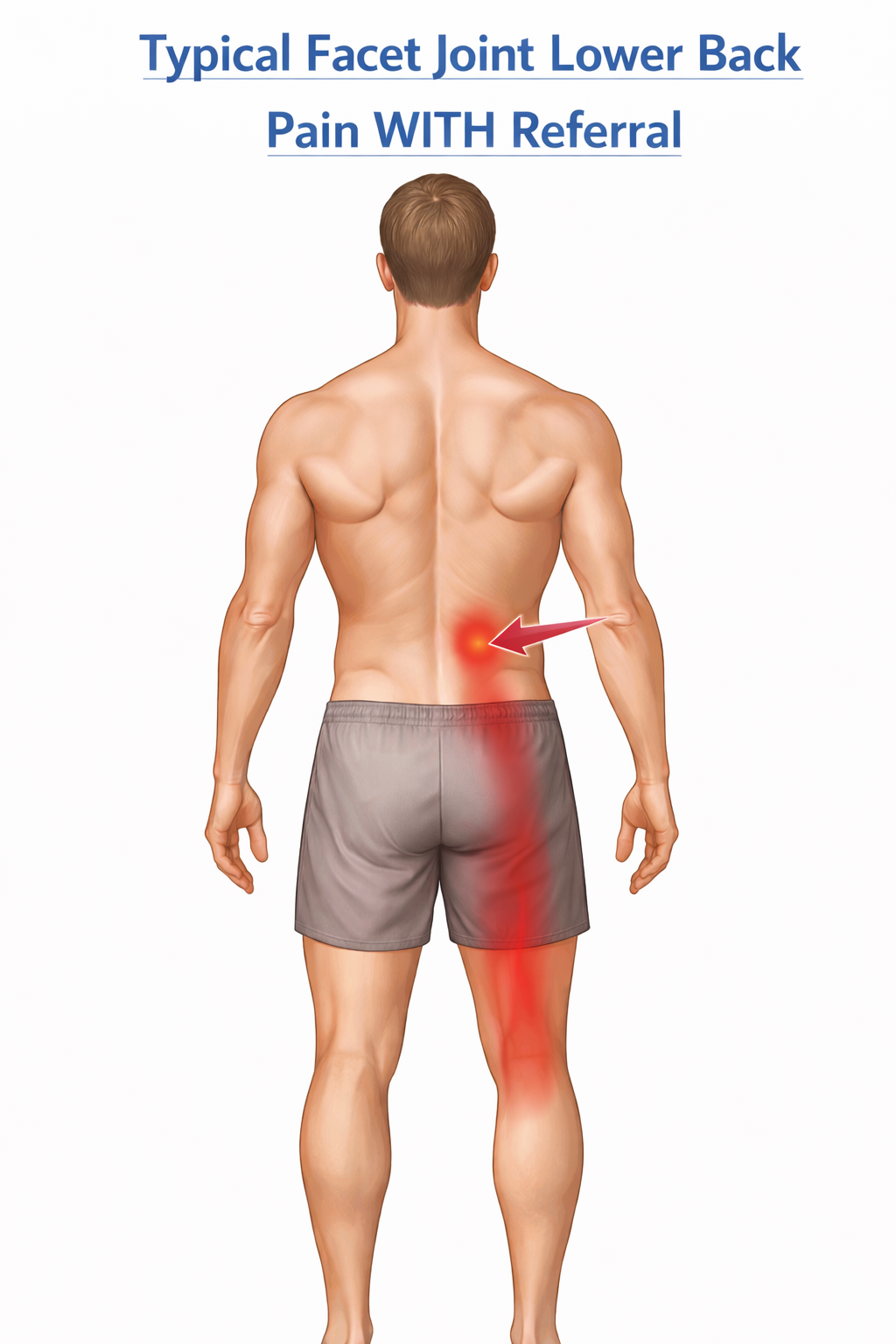
Referred pain that is from the facet joint most commonly stops above the knee.
👉 Read more about Disc Injury & Sciatica Treatment in London
Why Do Lumbar Facet Joints Become Irritated?
Facet joints are load-sensitive.
They tend to become irritated when repeatedly compressed in extension — especially if other areas of the body are not functioning optimally.
Common contributing factors include:
1. Repeated Lumbar Hyperextension
Heavy lifting, certain gym movements, or prolonged standing with excessive arching.
2. Poor Anterior Abdominal Control
If you cannot control trunk extension under load, the lumbar spine drifts into hyperextension.
3. Lumbopelvic Control Deficits
Difficulty controlling pelvic position — particularly into posterior pelvic tilt — increases posterior compression.
4. Limited Hip Extension (Very Common)
If the hips don’t extend properly, the lower back compensates.
Limited hip extension → lumbar hyperextension → repeated compression → facet irritation.
5. Inner Range Glute Inhibition
If the glutes aren’t functioning effectively in inner range, the lumbar spine absorbs more load.
Facet pain is rarely random.
It is usually a compensation pattern driven by load and movement.
How I Manage Lumbar Facet Joint Pain
Management depends on stage and irritability.
Phase 1: Reduce Pain & Restore Mobility
In acute stages, the priority is to:
Reduce pain
Restore pain-free lumbar movement
Improve confidence with motion
This may involve:
Targeted manual therapy
Dry needling (if appropriate)
Temporary modification of aggravating movements
The aim is not just symptom relief — but restoring controlled mobility.
Phase 2: Restore Lumbopelvic Control
Once pain reduces, we address what caused it.
We often begin with:
Posterior Pelvic Tilt Control
Teaching controlled pelvic positioning to improve anterior abdominal activation and reduce excessive extension tone.
Layering Movement
Progressing to:
Glute bridges (maintaining pelvic control)
Banded abdominal work
Planks and side planks
Core stabilisation is typically well tolerated and restores load tolerance safely.
Targeting Hip Flexors & Inner Range Glutes
A common pattern I see:
Shortened hip flexors
Inhibited inner range glutes
One of my preferred exercises is:
Prone hip extension (with pillows under the abdomen if needed)
This helps:
Reduce lumbar extension bias
Improve inner range glute activation
Encourage true hip extension
It directly addresses the compensation pattern.
Long-Term Management: Preventing Recurrence
Settling pain is the easy part.
Long-term success requires addressing the drivers:
Anterior abdominal control into extension
Lumbopelvic positioning under load
Inner range glute function
Restoring hip mobility
Gradual reintegration of extension-based movements
If extension was painful, we eventually reintroduce it — in a controlled and progressive way.
Avoidance creates sensitivity.
Progressive loading builds resilience.
What About Spondylolisthesis?
Spondylolisthesis (slipped vertebrae) without nerve referral can often present similarly to facet joint irritation. In fact, conservative management of a Spondylolisthesis is very similar to that of a facet joint problem (albeit much slower and more conservative progress).
In many cases, this is effectively posterior element loading — meaning facet-related stress.
If you’ve been told you have a spondylolisthesis, this may be relevant:
👉 Read more about Spondylolisthesis & Back Pain in Active Adults here
Correct diagnosis matters — because while management overlaps, nuance is important.
A skilled Physiotherapist may be able to suspect a Spondylolisthesis via a clinical examination (palpating a step deformity in the lumbar spine).
Watch: My Video Explanation of Facet Joint Pain
If you’d prefer a visual explanation, I break this down clearly in my YouTube video on facet joint pain, including:
What the facet joint is
How extension irritates it
What helps settle it
👉 Watch here: https://youtu.be/bHCmSpP0O2s
This complements the written explanation above.
When to See an athletic Spinal Physio in London
Most acute back pain should settle within 6 weeks, however if your pain has been lingering around for more than that, or its a recurrent injury that you want to get to the bottom of, it’s always best to have a review with a Spinal Physiotherapist experienced in managing these types of injuries.
A structured assessment can clarify whether the facet joint is involved — and what needs addressing.
You can learn more about my approach to:
👉 Lower Back Pain Treatment for Athletic Adults in London
About the Author
Ryan Tan
Sports & Spinal Physiotherapist in London specialising in athletic adults with persistent lower back pain.
Ryan works with active professionals across London Bridge and Canary Wharf, helping them understand the root cause of their back pain and rebuild strength through structured, gym-based rehabilitation.
With a strong background in spinal biomechanics and load management, his approach goes beyond symptom relief — focusing on long-term resilience and performance.
If you are searching for a sports physiotherapist in London experienced in managing lumbar facet joint pain and athletic lower back injuries, you can learn more about his services here: