Why Improving Tendon Pain Is Not an automatic Green Light to Return to Sport
If you’ve been dealing with Achilles, patellar, or elbow tendon pain, this scenario may sound familiar:
Your pain finally settles.
Training starts to feel easier.
You return to sport…
And within weeks, the pain is back.
As a sports physiotherapist working with runners, gym-goers, and athletes across London, this is one of the most common — and preventable — breakdowns I see in tendinopathy rehabilitation.
The mistake isn’t a lack of effort.
It’s a misunderstanding of what pain improvement actually means.
Pain and Tendon Recovery Do Not Follow the Same Timeline
One of the most important (and underappreciated) concepts in modern tendinopathy management is that pain and tendon structure recover on completely different timelines.
Clinically and in research, we consistently see that:
Tendon pain often improves within 6–12 months
Structural tendon adaptation can take 1–3 years
Pain reduction does not equal restored tendon capacity
This mismatch explains why many people feel “ready” — but aren’t actually prepared for sport-specific demands.
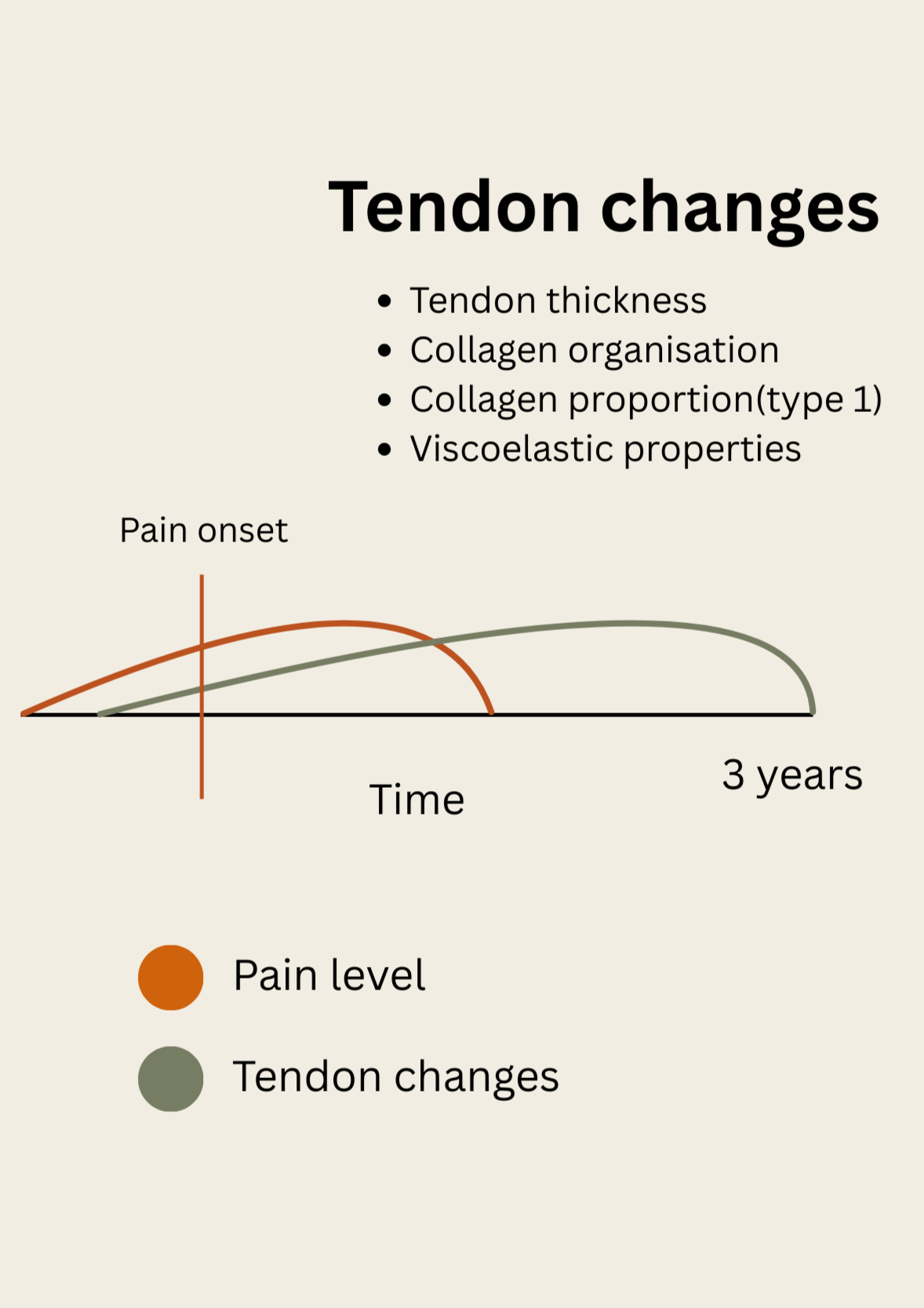
This image depicts PAIN and TENDON ADAPTATION having different timelines on the recovery journey.
Why Pain Settling Alone Is a Dangerous Return-to-Sport Signal
Pain is an output of the nervous system, not a direct measure of tissue capacity.
You can be pain-free during:
Walking
Gym exercises
Light jogging
…while your tendon is still unable to tolerate high-load, high-speed, or repetitive elastic demands.
In clinic, this often presents as:
Reduced load tolerance (can’t run 10km, unconfident playing football etc).
Poor rate of force development (can’t jump as high, not as powerful)
Inadequate energy storage and release (loss of ‘spring’ during jumping)
Compensatory movement strategies elsewhere in the kinetic chain (other joints start hurting)
All of which dramatically increase reinjury risk.
Pathological Recovery Is Essential for Performance — Especially the Stretch-Shortening Cycle
Here’s the critical distinction that changes how tendinopathy should be rehabilitated:
Pathological recovery is essential for restoring function and performance — particularly the tendon’s ability to tolerate and efficiently utilise the stretch-shortening cycle (SSC).
Tendons are not passive ropes. Their primary role in sport is to store, transmit, and release elastic energy during movements such as:
Running
Jumping
Hopping
Acceleration and deceleration
Change of direction
Without sufficient structural recovery, this elastic recoil mechanism remains impaired — even if pain has settled.
In practical terms:
You may feel fine at rest or during controlled exercise, but the moment sport demands rapid loading and unloading, the system fails.
What High-Quality Tendinopathy Rehab Actually Requires
Effective tendinopathy rehabilitation doesn’t start with exercises — it starts with assessment.
1. A Thorough Sports Physiotherapy Assessment
A skilled sports physiotherapist will first establish what we call the load–pain relationship.
The key question isn’t:
“Does it hurt?”
It’s:
“How much load can this tendon tolerate — and under what conditions?”
This relationship guides every stage of rehabilitation.
Load tolerance testing for calf capacity. Here, we are seeing how much load (weight) a client can tolerate while maintaining a neutral ankle position.
2. Establishing Load Tolerance Across Rehab Stages
Early Stage
The goal is to understand baseline tensile load tolerance.
For example (Achilles tendinopathy):
How many single-leg heel raises can be performed?
At what point does pain appear?
How does the tendon respond during and 24 hours after loading?
This gives us a clear starting point without provoking unnecessary flare-ups.
Mid Stage
As symptoms improve, assessment shifts toward force production and asymmetry.
This may include:
Heavier standing and seated calf raises
Comparing side-to-side strength
Force plate or dynamometer testing where available
Here, we are no longer just managing pain — we are quantifying how much force the tendon can produce and tolerate.
Late Stage / Return-to-Sport Phase
This is where many rehab programs fall short.
At this stage, the tendon must tolerate:
Hopping and bounding
Running progressions
Acceleration and deceleration
Change of direction
Repeated dynamic stretch-shortening cycles
Pain-free gym work does not mean readiness for this phase.
Here, we have assisted single leg ‘hops’ or ‘Pogos’. This is a basic, entry level test for the Achilles’ stretch shortening cycle capacity.
Why Tendon Structure Matters: A Brief Look at Pathophysiology
Understanding the underlying tendon changes helps explain why pain and performance often disconnect.
Common pathological features in tendinopathy include:
Increased ground substance within the tendon matrix
Excess water retention, altering viscoelastic behaviour
Disorganised collagen fibre alignment
Reduced proportion of Type I collagen fibres (responsible for tensile strength)
Increased tendon thickness without proportional strength gains
These changes impair the tendon’s ability to:
Store elastic energy
Rapidly recoil
Tolerate high strain rates
Functionally, the tendon behaves less like a stiff spring and more like a shock absorber that leaks energy — particularly problematic for running and jumping sports.
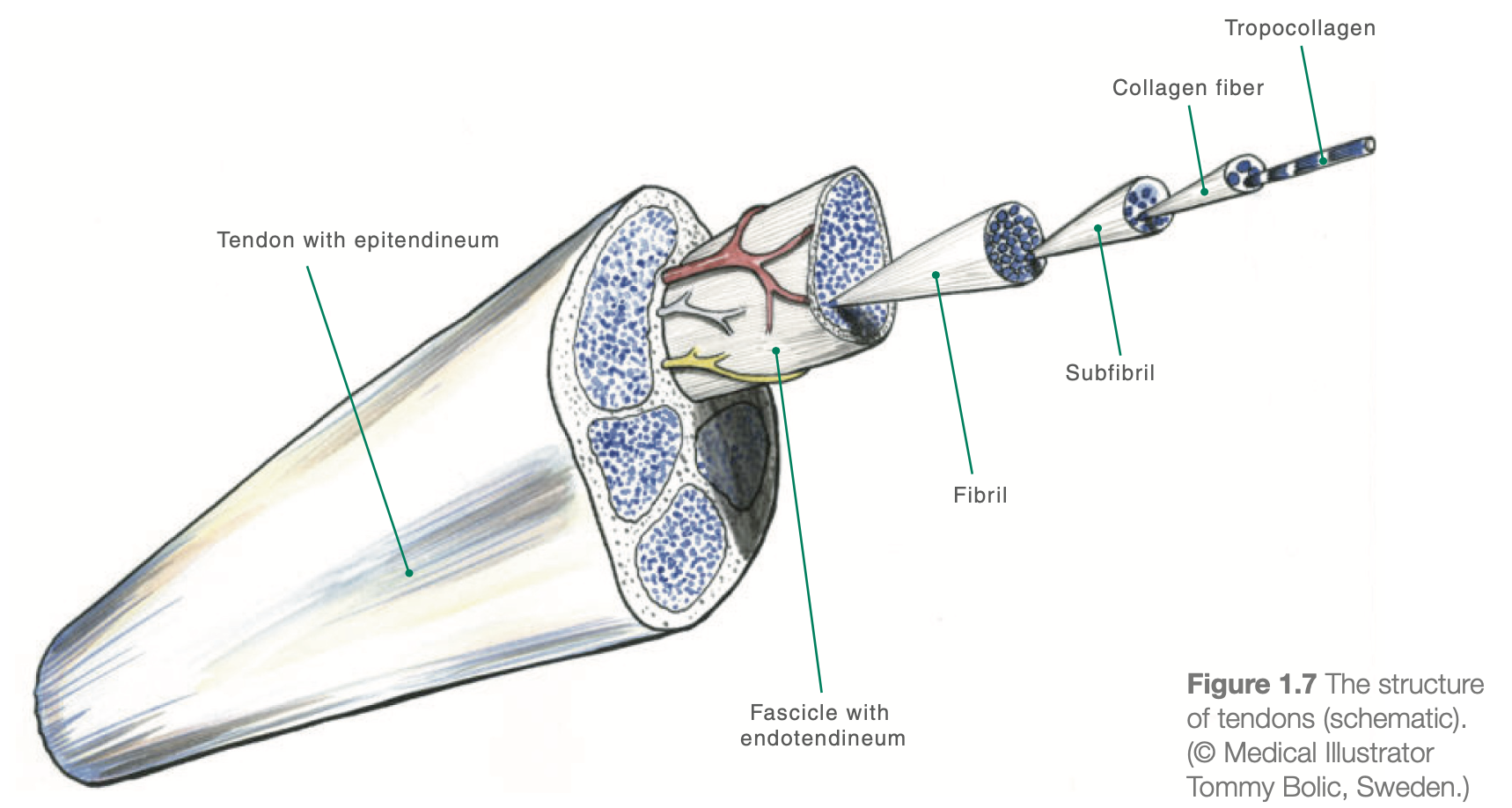
Image showing the macro and microscopic structure of a health tendon.
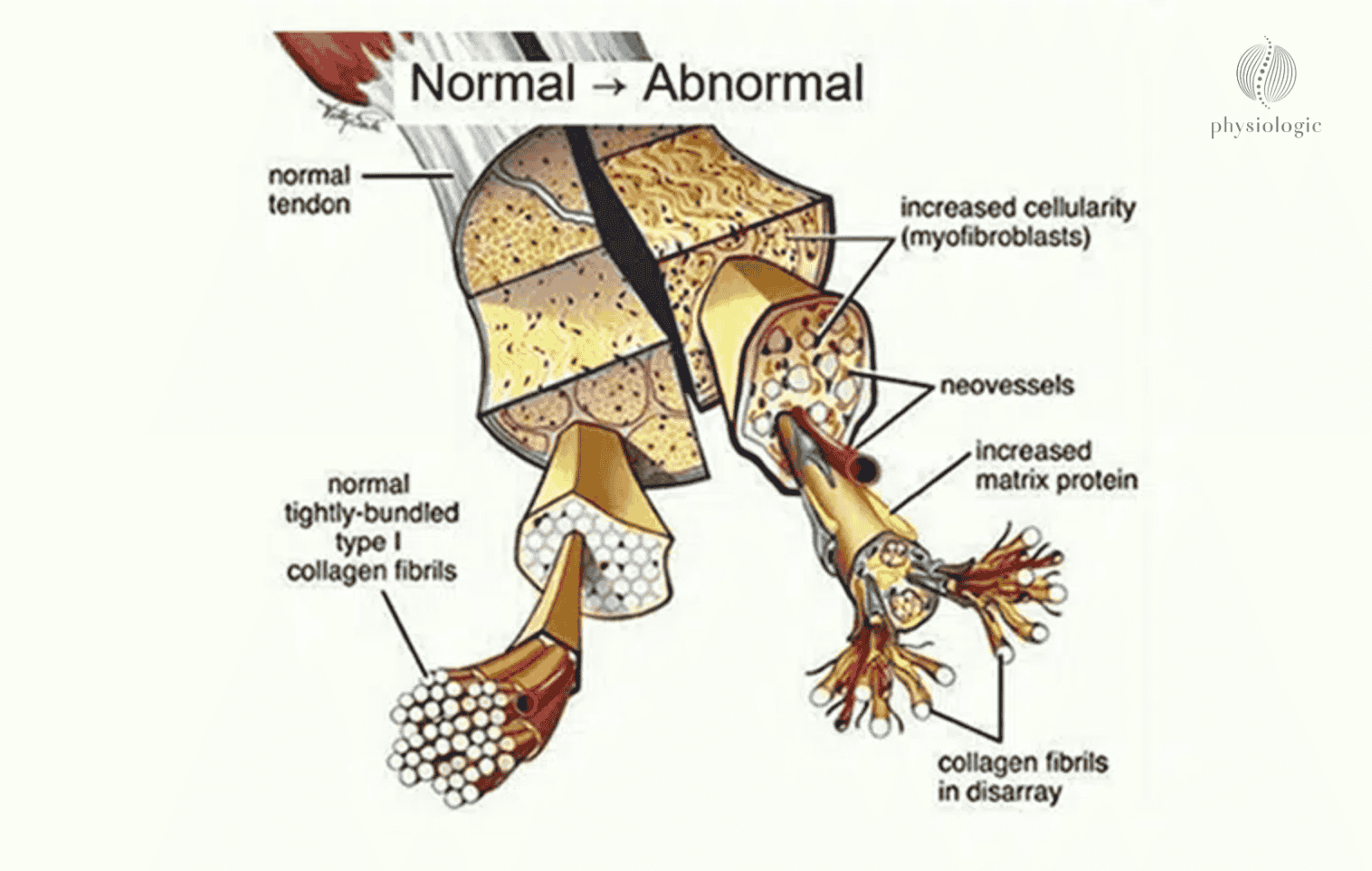
Image depicting a pathological (injured) tendon that shows collagen disorganisation.
Why “Rest Until It Feels Better” Falls Short
Rest often reduces pain — but at a cost.
Without appropriate loading:
Tendon stiffness declines
Load tolerance drops
Return-to-sport capacity worsens
Modern sports physiotherapy focuses on strategic, progressive loading, not avoidance.
A Smarter Return-to-Sport Framework for Tendinopathy
The right question isn’t:
“Does it hurt anymore?”
It’s:
“Is my tendon capable of tolerating the demands of my sport?”
Answering that requires:
Structured, progressive rehab
Objective strength and loading benchmarks
Gradual exposure to SSC demands
Individualised programming based on sport and goals
Final Takeaway
Improving tendon pain is not a green light to return to sport.
It’s simply the first checkpoint. Rehab for tendinopathies can take years, especially in elite athletes.
True recovery means restoring tendon strength and capacity — especially its ability to tolerate and recycle elastic energy under real sporting demands.
This is the difference between rehab that settles symptoms and rehab that actually holds up under pressure.
About the author
Ryan Tan is an Australian-trained sports physiotherapist based in London, with international clinical experience treating athletes and active individuals with complex tendon, spinal, and sports-related injuries.
Ryan specialises in tendinopathy rehabilitation, return-to-sport decision-making, and performance-focused rehab, bridging the gap between pain relief and true tissue capacity. His clinical approach prioritises clear diagnosis, objective load assessment, and structured rehabilitation — not short-term symptom management.
He has worked extensively with runners, gym-based athletes, and sporting populations who have failed traditional rehabilitation approaches, and is known for managing persistent tendon pain by restoring load tolerance, elastic capacity, and stretch-shortening cycle performance.
Ryan currently practises across multiple London locations and also provides education to fitness and health professionals on evidence-based rehabilitation and injury management.